Guardian Force Limited
Your Safety, Our Professional Commitment

Your Safety, Our Professional Commitment

Businesses across Bangladesh protect people, property, equipment, information, and daily operations. A shop, office, factory, warehouse, hospital, school, apartment complex, or construction site can face different security concerns. An open storefront may need help monitoring customer entry. A warehouse may need stronger control over vehicles and deliveries. An office may need a clear visitor process after working hours. The right security plan depends on the site, its operating hours, the people who use it, and the risks it faces.
Technology has an important place in that plan. Cameras can record activity, alarms can alert teams, and access systems can restrict entry. Yet these tools do not greet visitors, check a delivery note, notice a blocked exit, or explain an emergency procedure. Trained people can respond to situations in real time. This is why many business owners consider the benefits of hiring security guards as part of a wider safety and operations plan.
Professional security guards provide a visible, human presence at a business location. Their duties may include monitoring entrances, checking authorized access, observing the premises, recording incidents, supporting emergency procedures, and communicating with managers. These duties should be defined in writing and matched to the location. Guards do not replace law enforcement, fire services, building maintenance, or a company’s own safety responsibilities. They can, however, help a business notice concerns sooner and follow a consistent response process.
For a company in Bangladesh, choosing security guard services is also a matter of fit. A crowded commercial area in Dhaka, an industrial facility near a transport route, a retail outlet in Jashore, and a quiet office outside the main city do not have identical requirements. Businesses should assess their site before deciding how many guards they need, what hours require coverage, and what training the post demands. A service plan works best when it reflects the real movement of staff, customers, contractors, and goods.
The phrase “security guard” can describe several different roles. Some guards stay at a reception desk and verify visitors. Others patrol a property, observe a gate, monitor a loading area, or help control access during an event. A guard may also keep a written log, report hazards, contact a supervisor, or help staff follow an evacuation plan. The exact responsibilities depend on the assignment and the agreement between the business and the security provider.
Professional security guards should receive clear post orders before beginning work. Post orders explain where to report, what to observe, whom to contact, how to record activity, and what steps to take when a situation falls outside routine operations. They should also make clear what a guard is not authorized to do. Clear instructions protect the business, employees, visitors, and the guards themselves. They reduce confusion during a shift change or an unexpected event.
A guard’s value comes from reliable attention and sound judgment, not from a uniform alone. Businesses should look for a provider that explains recruitment, identity checks, training, supervision, replacement coverage, and incident reporting. In Bangladesh, the Private Security Services Act, 2006 sets a legal framework for private security service providers. It includes provisions concerning provider licensing and guard recruitment and training. Businesses can ask potential providers to explain how their operations meet applicable requirements and what documentation they can share.
One of the commonly cited benefits of hiring security guards is deterrence. A staffed entrance or visible patrol signals that someone is paying attention to the site. That presence can make a person reconsider unauthorized entry, attempted theft, trespassing, or other disruptive conduct. It also shows employees and visitors that the business treats site security as a regular responsibility.
Deterrence is not a guarantee. A guard cannot prevent every incident, and a visible post should not be presented as a promise of complete protection. Its practical value is that it adds observation and accountability. When a location has clear entry rules, working lights, maintained doors, and a guard who follows post orders, it becomes harder for routine checks to be ignored. A business should pair the human presence with sensible physical controls and review them as its operations change.
The placement of a guard matters. A guard positioned where people naturally enter can welcome visitors and notice unusual access attempts. A post hidden from the main approach may not provide the same benefit. Businesses should identify the entrances, service gates, parking areas, and delivery points that matter most. A provider can then recommend a suitable post and patrol pattern based on the site layout and operating hours.
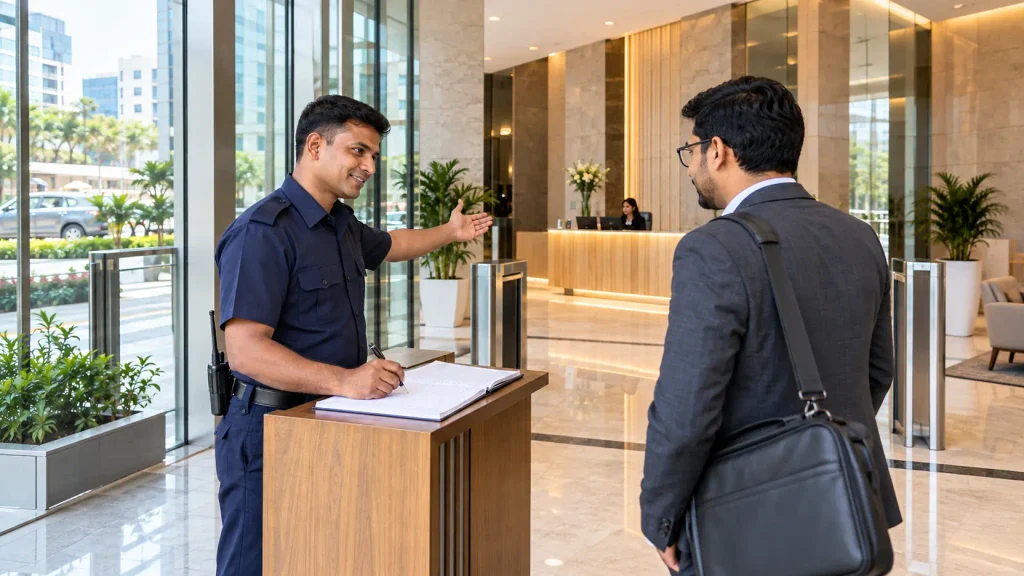
Many security concerns begin with uncertainty about who is on the premises. A steady stream of customers, suppliers, repair workers, job applicants, and contractors can make it difficult for staff to recognize everyone. A trained guard can support a visitor process by greeting people, asking the purpose of the visit, contacting the host, issuing a pass where appropriate, and recording entry and exit details according to company policy.
A consistent process helps the business apply the same rules to everyone. Staff know where to direct a guest. Visitors know whom they are meeting. Contractors can be asked to follow site-specific instructions before entering restricted areas. Delivery vehicles can be directed to the proper gate or loading point. These steps improve order at busy entrances and reduce unnecessary movement through work areas.
Access checks must respect the business’s policies and applicable law. Guards should not collect more personal information than the business needs, keep records longer than policy permits, or make decisions beyond their authority. The company should define which areas are restricted, who may approve access, how visitor records are handled, and how exceptions are escalated. Professional security guards can carry out that process more consistently when managers provide clear instructions and support.
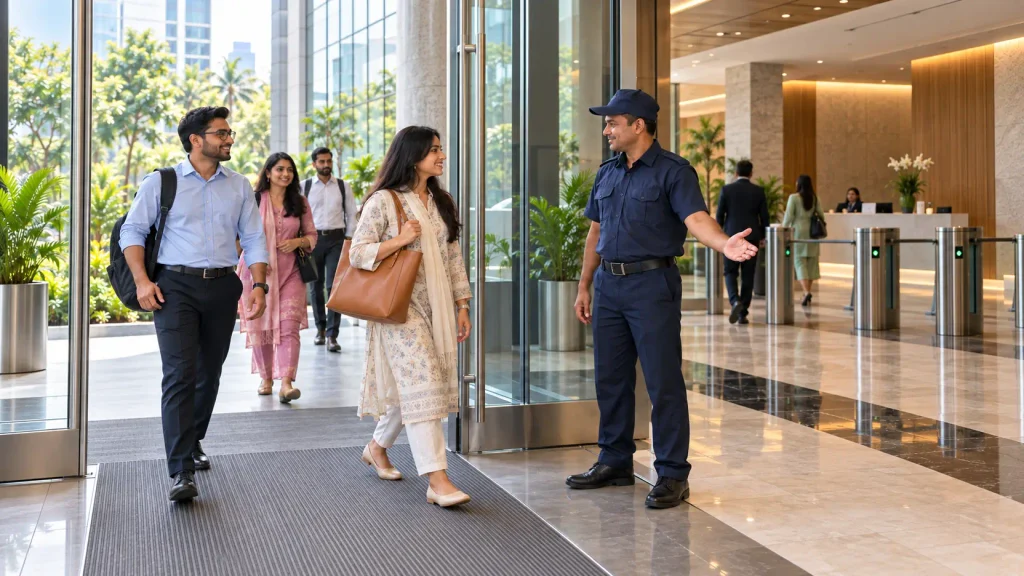
A safe workplace depends on many things: sound equipment, clear procedures, responsible management, and people who know how to raise concerns. Security guards can add a visible point of contact for staff and visitors who need help locating reception, reporting suspicious activity, or responding to an access issue. Their presence may be especially useful at entrances, car parks, reception areas, and locations that remain open after normal business hours.
Security staff can also support a calm response when a visitor is upset or a disagreement develops. A well-trained guard should follow the company’s escalation process, use respectful communication, and contact a manager or emergency service when needed. The role is to observe, communicate, and follow approved procedures. Businesses should not expect guards to act as medical professionals, firefighters, or police officers unless the person holds the relevant qualifications and the role is legally permitted.
Employees often feel more confident when they understand how to request assistance. A business can introduce guards to staff, explain the guard’s responsibilities, and share the right way to report a concern. This simple orientation prevents misunderstandings. It also helps employees understand that guards are part of a coordinated workplace process rather than an unknown presence at the gate.
A camera can capture an image, but a person on site can notice context. A guard may see a door left open, a delivery placed in the wrong area, a damaged fence, an unfamiliar vehicle, a spill near a walkway, or a visitor who needs directions. Early reporting gives a manager a chance to address a small issue before it disrupts more of the operation.
Good reporting is factual and timely. A guard should note what happened, when it happened, where it happened, who was notified, and what immediate action was taken under the post orders. Clear incident reports help managers identify recurring problems. For example, repeated access issues at one gate may indicate that signage is unclear or a door closer needs repair. A pattern of late deliveries may call for a change in scheduling rather than a security response.
Businesses should agree on the reporting format before service begins. They should know whether reports are submitted during a shift, at the end of a shift, or through a supervisor. They should also know how urgent matters are communicated. A well-managed business security services plan includes a path from observation to action, so information does not sit unread in a logbook.
Opening and closing a site can create predictable periods of activity. Staff may arrive before the main team, cash or stock may be moved, lights may be switched on, and doors may be unlocked. At closing time, employees may leave in small groups, equipment may be secured, and entrances may remain open while deliveries are completed. A guard can help the business apply a repeatable checklist during these transitions.
A checklist can cover visible signs of forced entry, doors and windows, restricted rooms, visitor areas, lighting, delivery gates, and the status of alarms. It should be tailored to the site and assigned to the right people. A guard can perform designated checks and report findings, while employees remain responsible for business tasks assigned to them. This division of duties keeps accountability clear.
The business should avoid relying on informal instructions that change from one shift to another. Written procedures make it easier to hand over information and train replacement personnel. If an opening or closing routine changes because of a new schedule or construction work, the manager should update the post orders and tell the security provider. Consistency is a practical benefit of commercial security guards when the service is supervised and documented.
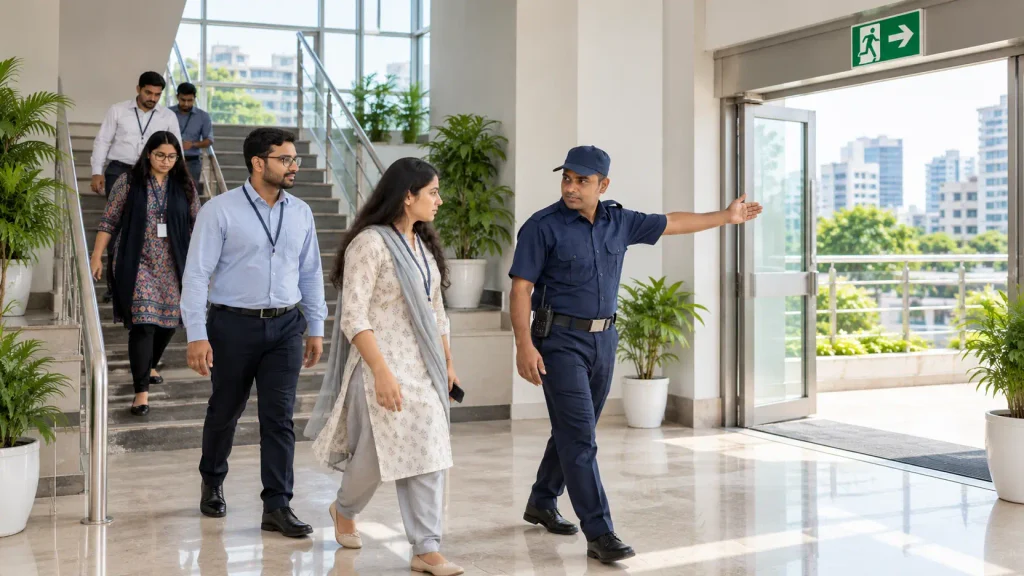
An emergency can confuse even when a company has a written plan. Visitors may not know where to go, employees may be unsure who should call for help, and managers may need information from more than one part of the site. A guard who understands the site layout and the company’s procedures can support communication, direct people toward approved exits, and report conditions to the designated contact.
The role must remain within the guard’s training and authority. Businesses should define who calls the fire service, ambulance, police, building management, or utility provider. They should explain how an incident is escalated, what information should be communicated, and which areas should remain clear. Guards should take part in relevant briefings and drills when appropriate. Managers should also make sure that exits, alarms, first-aid supplies, and other safety equipment are maintained by the responsible teams.
A guard cannot substitute for an emergency plan. The business must create and maintain its own procedures, train employees, and follow relevant requirements. The Dhaka Metropolitan Police guidance on safety for infrastructure is a useful local reference for organizations reviewing physical security considerations. Businesses should consult the appropriate authorities and qualified professionals for site-specific requirements.

Many businesses hold assets that are costly to replace or essential to daily work. These can include tools, computers, machinery, medicines, raw materials, finished products, vehicles, documents, and customer property. A guard can observe controlled areas, monitor authorized movement, and report unusual activity. A clear procedure for recording goods in and out can help managers keep better oversight of stock and equipment.
Warehouses and factories often have several movement points: staff entrances, vehicle gates, loading bays, storage rooms, and visitor areas. Commercial security guards can help direct vehicles, keep restricted zones clear, and communicate with staff responsible for inventory or dispatch. The business should define what information a guard may verify, which records must be checked by employees, and how discrepancies should be reported.
An office may have fewer deliveries but more sensitive records and equipment. A guard at reception can direct visitors and help prevent casual access to private work areas. A retail outlet may need attention around display stock, cash-handling routes, and closing routines. The plan should reflect the type of asset and the way people work around it. There is no single post arrangement that suits every organization.
Security and customer service can work together. A professional guard who knows the site can welcome a visitor, provide basic directions, explain where to check in, and contact the right employee. This is useful in buildings with multiple offices, clinics, educational institutions, factories, or service counters. A clear greeting helps visitors feel that they have arrived at the correct place while maintaining the entry procedure.
At a busy site, guards can help manage queues or direct people toward the correct entrance. During a delivery window, they can help keep vehicle routes clear and tell drivers where to wait. These tasks reduce confusion, but they should be agreed upon in the service scope. A guard should not be assigned so many reception or administrative duties that core observation and security responsibilities are neglected.
Managers should tell guards how to respond to common questions and where to direct requests they cannot answer. A simple site guide can include key contacts, office hours, emergency contacts, and restricted areas. Regular feedback from staff and visitors can show whether the arrangement is working. When business security services support both order and a welcoming experience, the guard becomes a helpful part of site operations.
A business may operate during the day, at night, on weekends, or across multiple shifts. Security needs can change with those hours. A daytime office may have many visitors and need reception support. A warehouse may be quiet overnight but still receive scheduled vehicles. A shop may be busiest near closing. A guard schedule should reflect actual activity rather than assume that every hour has the same level of risk.
Businesses with more than one location should also consider local conditions. A branch in a city center may face different access and traffic patterns from a site in a smaller town. A facility in Jashore may need a plan that accounts for its own building, hours, and nearby transport routes. The company can review location-specific needs and explore security services in Jashore when it needs a local service discussion.
Flexible coverage does not mean unclear coverage. The contract should state the number of posts, shift times, relief arrangements, supervisor visits, and the way absence is handled. If a business changes its hours or opens a new gate, it should review the schedule. This helps prevent gaps and gives both the business and provider a shared understanding of what service is being delivered.
A site may have several guards working different shifts. Without a good handover, one shift may not know that a visitor is expected, a repair is in progress, or a gate is temporarily unavailable. A written log and a brief handover process help the incoming guard understand relevant information. Managers can use the same process to communicate schedule changes and temporary instructions.
Consistency also depends on supervision. The provider should explain who supervises the guards, how often supervisors visit, how performance concerns are handled, and how replacement staff receives site instructions. The business should know how to reach a responsible contact at any time the post is active. An unstaffed or poorly supervised post can create confusion even when the service agreement appears complete.
Businesses should review the service periodically. Managers can compare the agreed duties with actual coverage, examine incident records, ask staff about recurring concerns, and discuss any change in foot traffic or operating hours. A short review helps identify whether the post still fits the site. Professional security guards are most useful when training, instructions, and supervision keep pace with business needs.
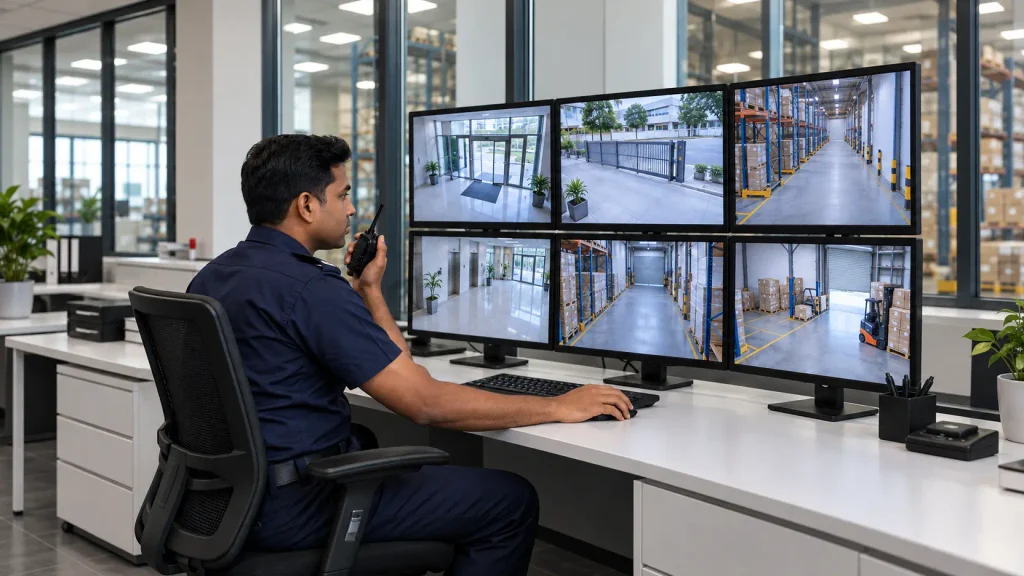
Cameras, alarms, lighting, access cards, and visitor systems can strengthen a site’s security. They can also create alerts that need a person to interpret them. A guard can observe activity in real time, follow an approved response procedure, and contact the person responsible for the system. If a camera records an event, a guard’s report may add useful context about what was happening at the scene.
Technology has limits. Cameras may have blind spots, alarms may activate because of a fault, and access cards can be lost or shared. Guards also have limits: they cannot see every area at once, and they cannot guarantee that every event will be prevented. Combining trained people with suitable technology and clear procedures can give a business more complete coverage than relying on one measure alone.
A business should map how each tool is used. It should identify who monitors alerts, who can review footage, how access permissions are approved, and what happens when a device stops working. Guards need only the system access required for their role. Managers should coordinate the provider with the team responsible for information security and privacy, especially when visitor records or surveillance footage are involved.
Small companies often start with a single office or shop and later add branches, storage areas, or longer hours. Their security arrangements may need to change as visitor numbers, staff levels, stock value, and site layout change. Outsourced security guard services can give a business the option to discuss adjustments with a provider rather than recruit and manage every post directly. The exact flexibility depends on the contract and the provider’s staffing capacity.
A growing organization can start by identifying the most important posts. It may need reception coverage at one location, a gate post at another, and occasional event support at a third. It should document the purpose of each post and review the arrangement after a new opening or operational change. This helps the business avoid paying for duties that do not support its actual needs.
Scaling should be planned, not improvised. Before adding a guard or extending hours, a manager should confirm the schedule, supervision, relief coverage, responsibilities, and reporting process. The provider should receive updated site information and post orders. When a business closes a location or changes its use, it should also update or end the relevant service properly.
Recruiting, scheduling, briefing, and supervising in-house security staff takes management time. Outsourcing may allow a business to delegate some staffing and supervision tasks to a specialist provider. Managers can then focus more attention on their core operations while still setting the site’s security requirements and checking that the service meets them.
Outsourcing does not remove the company’s responsibility to manage its premises. The business still needs to select a suitable provider, explain the site, approve procedures, communicate changes, and review performance. It also remains responsible for tasks that belong to its own employees, such as managing inventory, maintaining equipment, and deciding who is authorized to enter specific areas.
The right comparison is not only the monthly fee. Businesses can compare the full management effort involved in hiring directly with the proposed outsourced arrangement. They should ask what is included, how supervisors support the post, whether relief coverage is available, and how incidents are reported. A clear scope makes it easier to understand what the business is buying and where internal ownership remains necessary.
Security should be budgeted around real needs. A company can start with a site assessment, identify high-priority areas, and decide which hours and duties require a guard. It may then compare the expected cost of coverage with the cost of staffing, training, uniforms, supervision, leave cover, and administration for an in-house team. The result will depend on the size and schedule of the operation.
Hiring guards does not automatically reduce costs, and a low price does not always represent good value. If the schedule is unrealistic, a post may be left uncovered,d or a guard may be assigned too many responsibilities. If duties are vague, the business may pay for a service that does not address its main concerns. A detailed proposal should list post locations, shift lengths, number of guards, supervisory arrangements, reporting, and any additional charges.
Businesses should ask providers to explain how they price the service and what could change the price. They can also request a review date to consider whether the number of posts remains suitable. The objective is a practical level of coverage with accountable delivery. A documented scope helps managers compare business security services on more than a headline rate.
People notice how an organization manages access and responds to concerns. A staffed entrance, clear visitor process, and orderly delivery area can give employees and guests confidence that the company pays attention to its premises. Vendors and clients may also appreciate knowing where to report, whom to contact, and how to move through a site without interrupting operations.
Confidence should come from competent service, not an exaggerated security promise. Businesses should tell employees what the guard can assist with and how concerns are escalated. They should avoid suggesting that a guard can eliminate risk or guarantee personal safety. Transparent communication sets realistic expectations and encourages everyone to follow the same procedures.
A positive experience depends on conduct. Guards should be punctual, respectful, alert, and familiar with the site. The business can establish expectations for appearance, language, visitor interaction, and confidentiality. It should also provide a way for staff to raise concerns about service quality. In this way, the guard’s presence can support trust while maintaining appropriate boundaries.
Businesses sometimes host product launches, training sessions, public meetings, recruitment drives, or seasonal sales. These events can increase the number of visitors and create unfamiliar movement through the building. An event plan can specify where guests should enter, where they should wait, how staff will verify invitations, and which routes must remain clear. Guards can help implement those arrangements under the direction of the event organizer.
Busy periods can also occur during routine operations. A retail promotion, month-end dispatch, audit, or large delivery may create additional queues and vehicles. A temporary change in post coverage may help keep people moving through the correct areas. The business should provide the provider with the date, expected visitor volume, site map, emergency contacts, and event-specific instructions in advance.
The number of guards required will depend on the venue, event size, entry points, and the responsibilities assigned to the team. Businesses should not assume that the same arrangement works for every event. A provider can discuss whether temporary commercial security guards are appropriate and how they will coordinate with the company’s event staff.
Some premises contain rooms or zones that only approved people may enter. Examples include server rooms, cash offices, medicine storage, confidential document areas, production floors, laboratories, and staff-only spaces. A guard can reinforce the access procedure at a checkpoint, direct visitors to approved areas, and report attempts to enter without authorization.
The business must decide who has permission to enter and how it is confirmed. Guards need a current access list, a clear escalation contact, and instructions for temporary exceptions. If a person’s access changes, the responsible manager should update the system and tell the guard team when necessary.
Restricted access also depends on physical arrangements. Doors should close correctly, signs should be visible, and credentials should be managed by the appropriate team. Guards can report a faulty lock or a door that is routinely propped open; the business should arrange repairs and address the cause.
Retail businesses may focus on entrances, customer areas, stock rooms, cash procedures, and opening or closing routines. An office may focus on visitor registration, staff access, reception coverage, and after-hours entry. A factory may need attention to vehicle gates, contractor movement, loading areas, and restricted production spaces. A warehouse may focus on deliveries, dispatch records, perimeter observations, and movement around valuable stock.
Healthcare and education sites require careful attention to visitors and public access. A guard may direct visitors, support reception, and communicate concerns to the designated administrator. The post orders should reflect the needs of patients, students, employees, and caregivers. A security plan should also respect the privacy and dignity of people using the facility.
Construction sites change as work progresses. Materials, tools, temporary entrances, and contractor schedules may change from week to week. Managers should update the guard team when the site layout changes, new subcontractors arrive, or work hours shift. In each setting, the benefits of hiring security guards depend on matching the service to the type of property and the people who use it.
Choosing a provider is an important part of the security plan. Businesses should confirm that the company is properly licensed for the relevant services and ask for details about recruitment, identity verification, training, uniforms, identification, supervision, and incident reporting. They can request references or examples of similar assignments, then check whether the provider understands the business’s sector and site requirements.
The Private Security Services Act, 2006 includes requirements relating to licensing, guard eligibility, recruitment checks, and training. Businesses should review the current law and ask providers how they meet applicable obligations. They should also verify service coverage in the areas where they operate. If a provider serves multiple districts, the business can ask how it handles local coordination, supervisory visits, and changes in licensing or service arrangements.
A useful provider should ask questions before proposing a post. They may request a site visit, discuss operating hours, identify entry points, and ask how emergencies are escalated. A generic proposal that lists a monthly price without discussing the site may not give the business enough information. The company should be able to explain the service in plain language and show how the proposed duties address the needs identified by the manager.
Businesses evaluating security guard services can compare the stated service scope with their own priorities. They can also read the company’s information about a security guard company in Bangladesh and security services for businesses as part of their research. The decision should be based on the provider’s credentials, clarity, supervision, local reach, and fit for the site.
Before signing an agreement, ask direct questions about the service. Who recruits and verifies guards? What initial and ongoing training is provided? Who prepares the post orders? How are guards supervised? What happens if a guard is absent? How quickly can the provider fill an uncovered shift? Who receives an urgent call at night or on a public holiday? Clear answers help a business understand the operational arrangement.
Ask how the provider records attendance, patrols, visitors, and incidents. Confirm the format and timing of reports. Find out whether the business can review post instructions and request updates when operations change. If the guard is expected to monitor cameras, operate a gate, manage a visitor register, or support deliveries, those duties should be written down and included in the proposal.
The contract should define the service term, fees, payment schedule, overtime rules, replacement arrangements, cancellation terms, and responsibilities of both parties. It should also explain how the business raises a complaint and how the provider responds. Do not rely on informal statements about duties that are not reflected in the service documents. Written expectations help the relationship stay practical as the business grows.
A provider can supply personnel, but the business must share accurate information about the site. Before the first shift, identify entrances, exits, restricted rooms, emergency contacts, delivery zones, staff facilities, and areas that require additional attention. Provide a site map if available. Explain the normal schedule, expected visitor patterns, and any temporary work that could affect access or movement.
Managers should introduce guards to the staff who will work with them. Explain who can authorize visitor access, who approves changes to the post orders, and whom to contact when a concern arises. Decide how keys, cards, radios, registers, and other equipment will be issued and returned. Make sure the guard knows where to report for a shift and how to receive updates from the previous shift.
The first days of service are a useful time to check whether the arrangement fits. Managers can observe entry flow, ask staff for feedback, and review early reports. If a post is too far from the entrance or the guard lacks a necessary instruction, the company can discuss a practical adjustment with the provider. Early communication helps prevent small misunderstandings from becoming routine problems.
Hiring based on price alone can leave a business without supervision, relief coverage, site briefings, or reliable reporting. Vague responsibilities create another problem: a guard cannot follow a policy that has not been explained, and different shifts may apply different rules. Businesses should agree on duties and escalation contacts before service begins.
Guards should not be expected to solve problems that belong to another function. They may notice a broken light, but maintenance staff must repair it. They may record stock movement, but the inventory team must reconcile records. The company must maintain its emergency plan and train employees. A new entrance, changed work hours, renovation, or increase in visitors should also prompt a review of the service.
Review whether posts are staffed on time, patrols are recorded, reports arrive as expected, and urgent calls reach the right contact. Managers can also examine recurring access issues, staff feedback, and how quickly reported maintenance concerns are resolved. These measures show whether the agreed service is being delivered; they do not prove that every risk is controlled.
A full logbook does not automatically mean a site is safer, and a quiet month does not prove that the service has no value. Check whether the guard’s duties match current needs, incidents follow the agreed procedure, and the provider responds to concerns. A periodic review with the provider and relevant staff can cover operational changes, schedule issues, and training needs.
The main benefits can include a visible deterrent, more consistent access control, faster reporting of unusual activity, support for staff and visitors, orderly opening and closing routines, and help following emergency procedures. The exact benefit depends on the site, guard training, post instructions, and supervision. A guard is one part of a wider security plan and cannot guarantee that incidents will not occur.
They can be useful when a small business has a clear need, such as a busy entrance, valuable stock, late operating hours, or deliveries that require oversight. A small business does not always need full-time coverage. It can assess its operating hours and highest-priority areas, then discuss a suitable schedule with a provider. The plan should be proportionate to the site and budget.
There is no standard number for every business. The answer depends on the number of entrances, site size, operating hours, visitor volume, restricted areas, and the tasks assigned to each post. A provider should review the site and explain the basis for its recommendation. Businesses should confirm that breaks, shift changes, and absence coverage are included in the proposed arrangement.
No. Guards and technology perform different roles. Cameras can record activity and alarms can signal a change, while guards can observe, communicate, and follow procedures at the site. Many businesses use both. They should decide who monitors each system, how alerts are handled, and what happens when equipment fails.
A company should ask about licensing, recruitment checks, guard training, supervision, identification, reporting, relief coverage, and the provider’s experience with similar sites. It should review the proposed duties and contract terms. The business should also consider applicable legal requirements and confirm that the provider can serve the locations covered by the contract.
Yes. A guard can support a visitor process by greeting guests, checking the purpose of a visit, contacting a host, issuing a pass under company policy, and directing visitors to approved areas. The business should decide what information is recorded, how records are protected, and who can approve exceptions.
They can compare the management time, recruitment, training, supervision, relief coverage, and administration involved in each option. An in-house team may suit some organizations, while outsourced business security services may be more practical for others. The decision should reflect the site’s needs, the company’s capacity, service quality, and total cost.
The benefits of hiring security guards are strongest when the service has a clear purpose. Start by walking through the site at different times of day. Note who enters, which areas need controlled access, how deliveries move, what happens after closing, and whom staff contact when something seems wrong. Ask employees where procedures feel unclear. This short review can help the business describe its needs accurately.
Next, write down the required duties, coverage hours, reporting expectations, and escalation contacts. Invite providers to discuss the site and explain how they would staff and supervise it. Compare the proposals on their full scope, legal and operational documentation, training, local support, and cost. Then set a review date so that the arrangement can be adjusted when the business changes.
Businesses looking for a provider can review the Guardian Force homepage and contact the team through the contact page to discuss site-specific requirements. Readers can also see information about a security guard company in Jashore when comparing local coverage. A clear conversation about the location, hours, entrances, and responsibilities is the best starting point for a useful proposal.
Professional security guards can help a business maintain a visible presence, follow access procedures, report concerns, and support orderly daily operations. Their contribution depends on good training, written instructions, responsible supervision, and cooperation from the business. When those pieces are in place, security guard services can complement the company’s wider efforts to protect people, property, and work routines across BBangladesh.

The promotional offers here are insane. I managed to double my initial deposit thanks to the welcome bonus. You should definitely check brwin4444bet.
The VIP treatment here is actually real. I feel valued as a player and the exclusive perks are a nice touch. krvip is definitely the way to go.
If you are looking for a reliable site, give ph93jili a try. The gameplay is fair and the wins are satisfying.
Just hit a nice little jackpot here! The registration process was super easy and took like two minutes. br777win97 is legit.
Love the slot selection on this app. The graphics are crisp and the bonuses keep me coming back. Just downloaded winlislotsgamedownloadapk and I am already hooked.
The app version is way better than the browser. I can place my bets on the go without any lag. Great experience overall with betakiapp
Fantastic platform for those who love to bet on sports and casino games. The odds are fair and the user interface is very intuitive. Good luck at krbetwiner
The app installation was a breeze and it runs flawlessly on my phone. If you are looking for a stable download, pkz999gamedownload is the way to go.
Super easy to navigate and the deposit options are very flexible. It’s refreshing to find a site that focuses on the player experience. br56b
Honestly the best user interface I have encountered so far. Everything is easy to find and the bonuses are actually fair. Definitely giving vn888p another go tonight.
Everything from the layout to the payment methods is just perfect. It feels like they really know what players want. Definitely check out phbet160